Quick answer: Oocyte freezing cost in Bangalore is made up of tests, stimulation medicines, monitoring, egg retrieval, vitrification and yearly storage, plus a later thaw, ICSI and embryo transfer. As a broad, approximate guide, one freezing cycle has often cost about ₹1.5 to ₹2.5 lakh, but this varies by centre and individual protocol.
Key takeaways
- Medicines are the most variable part of the cost and depend on your age, AMH and response.
- Storage is charged every year, and using the eggs later is a separate cost.
- Age at freezing, not age at use, is the biggest factor in success.
- Many women need more than one cycle to bank enough eggs, which raises the total cost.
- The ART (Regulation) Act 2021 sets eligibility and storage rules for egg freezing in India.
What is oocyte freezing?
Oocyte freezing (egg freezing) means collecting a woman’s mature eggs after hormone stimulation and storing them at very low temperature using vitrification, a rapid-freezing method. The eggs can later be thawed, fertilised by ICSI and transferred as embryos.
Women consider it for medical reasons, such as before cancer treatment or surgery that may damage the ovaries, or for personal reasons, such as wanting to delay pregnancy. For a deeper look at timing, see our guide on egg freezing age and success rate.
What does oocyte freezing cost in Bangalore?
There is no single price, because the total depends on your medicines, the number of cycles and how long you store your eggs. Ranges quoted below are broad and approximate only, and vary by centre and individual protocol.
| Cost component | What it covers | What changes it |
|---|---|---|
| Consultation and tests | AMH, antral follicle count, hormone and infection screening | Extra tests needed for your history |
| Stimulation medicines | 8 to 12 days of hormone injections and a trigger injection | Dose, duration and brand, based on age and AMH |
| Monitoring | Usually 3 to 5 scans and blood tests | How quickly follicles grow |
| Egg retrieval and vitrification | Day-care procedure, anaesthesia, lab and freezing | Number of eggs frozen |
| Annual storage | Keeping eggs in liquid nitrogen | Number of years stored |
| Future use | Thawing, ICSI, embryo culture and transfer | Number of attempts |
As a broad indication taken from earlier guidance, one freezing cycle has often been in the range of about ₹1.5 to ₹2.5 lakh, with storage roughly ₹10,000 to ₹30,000 a year, and a later thaw, ICSI and transfer cycle as a further significant cost. Treat these only as approximate; ask for a written, itemised estimate.
Which factors change the total cost?
Five factors account for most of the difference between one woman’s bill and another’s.
- Age and ovarian reserve: lower AMH often means higher medicine doses and fewer eggs per cycle.
- Number of cycles: women in their late thirties often need two or more cycles to bank enough eggs.
- Protocol and medicine brands: different protocols and drugs have different costs.
- Storage period: storing for many years adds up.
- Medical extras: treatment of cysts, polyps or other findings before stimulation.
Package prices may not include medicines, extra scans, storage after the first year or the eventual thaw cycle. Always ask what is included.
What is the step-by-step process of egg freezing?
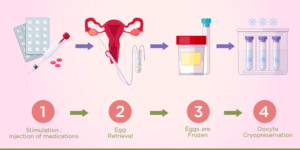
The active part of egg freezing takes about two weeks from the start of your period.
- Assessment: consultation, AMH, antral follicle count and baseline blood tests.
- Ovarian stimulation: daily hormone injections for about 8 to 12 days, usually self-given under the skin.
- Monitoring: scans and blood tests every 2 to 3 days to adjust doses.
- Trigger injection: given when follicles are ready, about 34 to 36 hours before retrieval.
- Egg retrieval: a 15 to 20 minute ultrasound-guided procedure under short anaesthesia. You go home the same day.
- Vitrification and storage: mature eggs are frozen and stored until you need them.
Most women return to work in a day or two. Mild bloating is common. Severe OHSS is uncommon with modern antagonist protocols.
What are the success rates of frozen eggs?
Success depends mainly on your age when the eggs were frozen and on how many mature eggs are stored. Not every egg survives thawing, fertilises or becomes a healthy embryo.
- Eggs frozen before 35 have the best chance of leading to a live birth.
- Larger studies suggest roughly 10 to 15 mature eggs frozen under 35 give a reasonable cumulative chance of one baby, while more are usually needed after 37 to 38.
- Egg freezing improves your options but cannot guarantee a pregnancy.
What does the ART (Regulation) Act 2021 say about egg freezing?
In India, egg freezing is regulated under the Assisted Reproductive Technology (Regulation) Act 2021 and its rules. The Act requires ART clinics and banks to be registered, requires written informed consent, and sets eligibility, including age limits for women receiving ART services (currently 21 to 50 years). It also limits how long gametes can be stored, with up to 10 years being the commonly applied period. Rules may be updated, so your clinic should explain the current position on storage and use before you begin.
When to see a gynaecologist
See a gynaecologist promptly, and before planning egg freezing, if you have:
- A new cancer diagnosis or planned chemotherapy or radiotherapy
- Endometriosis cysts or planned ovarian surgery
- Irregular or absent periods, or a family history of early menopause
- Very low AMH on a previous test
After egg retrieval, seek urgent help for severe abdominal pain or swelling, breathlessness, fainting, heavy bleeding or fever.
How Dr. Divya Venugopalan can help
Dr. Divya Venugopalan, a fertility specialist with a Fellowship in Reproductive Medicine (FRM) and over 14 years of experience, helps women decide whether egg freezing makes sense for them, and when. She starts with an honest assessment of ovarian reserve and explains likely egg numbers and costs before you commit.
Learn more on the egg freezing treatment page, or read about egg freezing for career women. If a partner is involved, sperm freezing or embryo freezing via IVF may also be discussed.
Book a consultation at Thanisandra, Sahakar Nagar or HRBR Layout, or call +91 99459 26987.
Frequently asked questions
Is egg freezing covered by insurance in India?
Most health insurance policies in India do not cover elective egg freezing. Some cover it when it is medically needed, such as before cancer treatment. Check your policy and any employer fertility benefits.
How many cycles of egg freezing will I need?
It depends on your age, AMH and how many eggs you want to bank. Women under 35 often reach their target in one cycle, while women in their late thirties or forties frequently need two or more.
Does egg freezing reduce my natural fertility?
No. Stimulation recruits follicles that would otherwise have been lost that month, so it does not use up your future egg supply or bring on early menopause.
How long can frozen eggs be stored?
Vitrified eggs remain stable for many years. In India, the ART (Regulation) Act 2021 and its rules limit the storage period, and your clinic will explain the current limit and renewal process.
What is the best age to freeze eggs?
Freezing before 35 gives the best results, and earlier thirties is ideal. Freezing up to the late thirties can still be worthwhile after an honest discussion of expected egg numbers and success.
Medically reviewed by: Dr. Divya Venugopalan, MBBS, DNB (OBG), FRM, FMAS. Gynaecologist & fertility specialist, Bengaluru (KMC Reg. No. 91293). Last reviewed: 27 October 2026.
This article is for general information and does not replace a personal consultation. In an emergency, visit the nearest hospital emergency department.