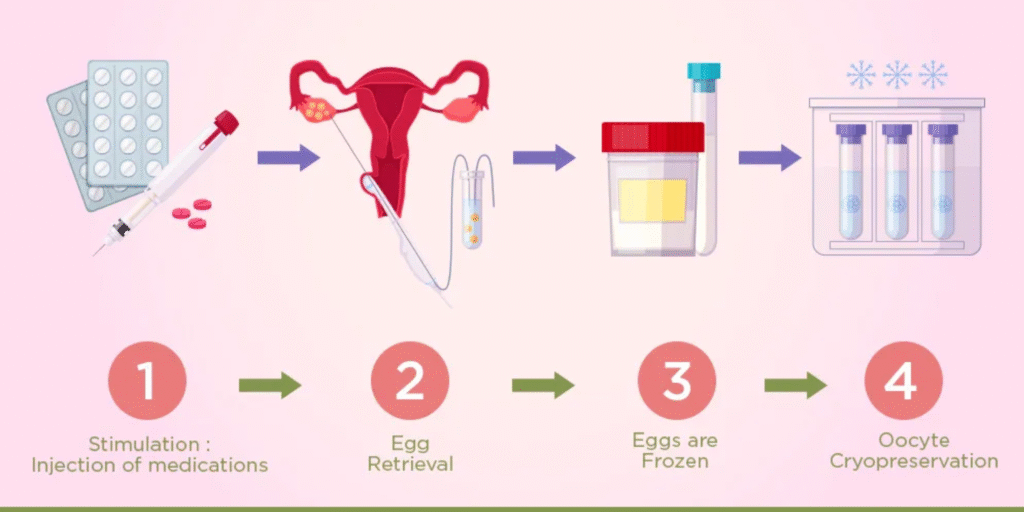
Quick answer: Your age when eggs are frozen is the strongest predictor of egg freezing success. Eggs frozen before 35 give the best chance of a live birth, often with around 10 to 15 mature eggs. After 37, more eggs and often more cycles are needed, and success per egg falls steadily, especially after 40.
Key takeaways
- Egg quality depends on the age at freezing, not the age when you use the eggs.
- Under 35, about 10 to 15 mature eggs give a reasonable chance of one baby; after 38, many more are needed.
- AMH and antral follicle count predict how many eggs you will get, not their quality.
- More cycles at an older age mean a higher total cost for a lower chance of success.
- Egg freezing improves your options but never guarantees a pregnancy.
Why does age matter so much for egg freezing?
Age matters because both the number and the genetic quality of eggs fall over time. A woman is born with all the eggs she will ever have, and as she gets older a larger proportion of them carry chromosomal errors.
Chromosomally abnormal eggs are less likely to fertilise, more likely to stop developing, and more likely to cause miscarriage. Freezing pauses this process: an egg frozen at 32 keeps the quality of a 32-year-old egg, even if it is used at 40.
What is the best age to freeze your eggs?
The best results are seen when eggs are frozen in the late twenties to early thirties, and ideally before 35. Freezing between 35 and 38 is still reasonable for many women after an honest discussion.
Very young women often do not need to freeze, because many will conceive naturally. The sweet spot balances a good chance of success against the possibility that you will never need the eggs. If you are 30 to 34 and unsure about pregnancy in the next few years, it is worth having an assessment now.
How many eggs do you need at each age?
The older you are, the more mature eggs you need to bank for the same chance of a baby. The figures below are approximate, based on published prediction models, and individual chances vary.
| Age at freezing | Approximate mature eggs for a reasonable chance of one live birth | Typical number of cycles |
|---|---|---|
| Under 35 | About 10 to 15 | Often 1 |
| 35 to 37 | About 15 to 20 | 1 to 2 |
| 38 to 40 | About 20 to 30 or more | 2 or more |
| Over 40 | Many more, and success remains low | Several; donor eggs may be discussed |
Each frozen egg has only a modest individual chance of becoming a baby, which is why the total number matters. Not every egg survives thawing, fertilises with ICSI or develops into a healthy embryo.
How do AMH and antral follicle count affect your plan?
AMH and antral follicle count (AFC) tell you how many eggs you are likely to collect, but not how good they are. Age remains the best guide to egg quality.
- Good AMH at a young age: the best combination. One cycle may be enough.
- Low AMH at a young age: fewer eggs per cycle, but each has good quality. Two cycles may be needed.
- Good AMH at an older age: plenty of eggs, but a higher share may be abnormal, so a larger number is needed.
- Low AMH at an older age: the hardest situation. An early, honest discussion of alternatives is important.
Conditions such as endometriosis, previous ovarian surgery, a family history of early menopause or upcoming cancer treatment can lower reserve faster. These are reasons to test earlier rather than later.
How does age change the cost of egg freezing?
Age affects cost mainly by changing how many cycles and how much medicine you need. A woman in her early thirties may bank enough eggs in one cycle, while a woman at 39 may need two or three.
- Medicines: lower reserve usually needs higher doses.
- Number of cycles: each extra cycle repeats monitoring, retrieval and freezing charges.
- Storage: charged yearly, so freezing earlier can mean more years of storage.
- Future use: thawing, ICSI and embryo transfer are separate costs.
As a broad, approximate guide, a single freezing cycle has often cost around ₹1.5 to ₹2.5 lakh, with older women more likely to need several cycles. This varies by centre and individual protocol. See our detailed breakdown of oocyte freezing cost in Bangalore.
Are there legal age limits for egg freezing in India?
Yes. Under the Assisted Reproductive Technology (Regulation) Act 2021, ART services for women are currently permitted between 21 and 50 years of age, and the Act limits how long gametes may be stored. Your clinic should explain the current rules on storage duration and later use before you start.
When to see a gynaecologist
Book an assessment sooner rather than later if you:
- Are over 32 and unsure about pregnancy in the next few years
- Have endometriosis, ovarian cysts or planned ovarian surgery
- Have a mother or sister who reached menopause before 45
- Have irregular, very light or absent periods
- Have been diagnosed with cancer or another condition needing treatment that can damage the ovaries
How Dr. Divya Venugopalan can help
Dr. Divya Venugopalan, a fertility specialist with a Fellowship in Reproductive Medicine (FRM), helps women understand their personal numbers. She combines your age, AMH and antral follicle count to estimate likely egg yield and explains whether freezing now, later or not at all makes sense.
Find out more on the egg freezing page, or read about egg freezing for career women. If you already have a partner, embryo freezing through IVF may also be discussed.
Book an appointment at Thanisandra, Sahakar Nagar or HRBR Layout, or call +91 99459 26987.
Frequently asked questions
Is 35 too late to freeze eggs?
No. Many women freeze eggs successfully at 35 to 37, though they may need more eggs and sometimes a second cycle. An assessment of AMH and antral follicle count helps predict what to expect.
Is it worth freezing eggs after 40?
Success with eggs frozen after 40 is low, and many cycles may be needed. It can still be considered after a frank discussion, but other options such as trying to conceive now or donor eggs are often discussed.
Does freezing eggs younger mean better quality later?
Yes. Frozen eggs keep the quality they had at the age they were frozen, so eggs frozen at 31 behave like 31-year-old eggs when used years later.
Can a high AMH guarantee egg freezing success?
No. A high AMH means more eggs are likely to be collected, but it says little about egg quality. Age is still the main predictor of how many eggs will become healthy embryos.
What is the age limit for egg freezing in India?
Under the ART (Regulation) Act 2021, ART services for women are currently allowed from 21 to 50 years of age. Your clinic can explain how this affects freezing and later use of your eggs.
Medically reviewed by: Dr. Divya Venugopalan, MBBS, DNB (OBG), FRM, FMAS. Gynaecologist & fertility specialist, Bengaluru (KMC Reg. No. 91293). Last reviewed: 27 October 2026.
This article is for general information and does not replace a personal consultation. In an emergency, visit the nearest hospital emergency department.