
Quick answer: When adenomyosis and deep endometriosis occur together, treatment starts with accurate mapping by expert ultrasound or MRI. Hormonal suppression controls symptoms in many women. Surgery to excise deep nodules is considered for persistent pain, organ involvement or fertility reasons, and is planned with the uterus, ovaries and future pregnancy in mind. Hysterectomy alone does not remove deep endometriosis.
Key takeaways
- Adenomyosis and deep endometriosis often coexist and share hormonal and inflammatory drivers.
- Deep endometriosis means nodules that infiltrate tissues such as the ligaments behind the uterus, bowel, bladder or ureters.
- Detailed pre-operative mapping is essential so that surgery is complete, safe and done once.
- Medical treatment is the first step for many women; surgery is individualised.
- Removing the uterus treats adenomyosis but not deep endometriosis elsewhere, which must be excised separately.
What does it mean to have adenomyosis with deep endometriosis?
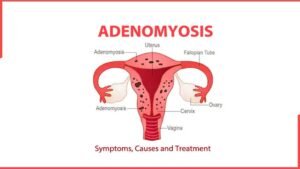
It means endometrial-like tissue is growing both inside the uterine muscle (adenomyosis) and deeply into tissues outside the uterus (deep endometriosis). The two are separate diseases that frequently occur together.
Deep endometriosis typically involves the uterosacral ligaments, the space between the uterus and rectum, the bowel wall, bladder or ureters. Together they tend to cause more severe symptoms than either alone. The individual conditions are introduced in endometriosis and adenomyosis symptoms and treatment.
What symptoms suggest both conditions are present?
The combination often causes heavy, painful periods along with deep pelvic, bowel or bladder pain.
- Heavy, prolonged bleeding and a bulky, tender uterus (adenomyosis)
- Deep pain during sex, especially in certain positions
- Pain on opening the bowels, rectal pain or bleeding during periods
- Pain or blood when passing urine around periods
- Lower back pain or pain radiating down the legs
- Difficulty conceiving
How are adenomyosis and deep endometriosis mapped before treatment?
Treatment planning depends on a detailed map of where disease is and which organs are involved. This is done with expert imaging rather than routine scans.
- Expert transvaginal ultrasound: a systematic scan of the uterus, ovaries, ligaments, bowel and bladder, including the sliding sign to check for adhesions.
- MRI pelvis: for extensive disease, suspected ureter or bowel involvement, or surgical planning.
- Kidney ultrasound: to check that a ureter is not blocked, which can happen silently.
- Further tests when needed: such as colonoscopy or cystoscopy to assess the bowel or bladder.
More on these tests is in endometriosis diagnosis: ultrasound, MRI and laparoscopy.
What medical treatment works for both conditions?
Because both conditions are oestrogen-dependent, the same hormonal medicines often help both, and many women control symptoms without surgery.
- Progestogens such as dienogest: reduce pain from both conditions.
- Hormonal IUS: particularly helpful for adenomyosis bleeding; often combined with an oral treatment for deep disease.
- Continuous combined pill.
- GnRH analogues with add-back therapy: for severe symptoms or before surgery.
- Pain relief: NSAIDs and, where needed, medicines for nerve-type pain.
Medical treatment does not shrink fibrous deep nodules much and is not suitable while trying to conceive. Details are in adenomyosis treatment options.
When is surgery needed, and what does it involve?
Surgery is considered when pain persists despite medicines, an organ such as the bowel or ureter is narrowed or blocked, endometriomas are large, or surgery may help fertility.
Laparoscopic excision of deep endometriosis
Deep nodules are cut out laparoscopically while preserving healthy tissue. When the bowel, bladder or ureter is involved, surgery may be planned jointly with a colorectal surgeon or urologist.
Dealing with the adenomyosis
If you wish to keep your uterus, adenomyosis is usually managed medically after surgery. A focal adenomyoma may occasionally be removed. If your family is complete, hysterectomy can be combined with excision of deep disease in the same operation.
Protecting the ovaries
Surgery on endometriomas can reduce ovarian reserve, so the approach is tailored to your age and fertility plans.
How do treatment choices differ by goal?
| Your main goal | Usual approach |
|---|---|
| Pain relief, no pregnancy planned soon | Hormonal suppression; surgery if it fails or organs are affected |
| Pregnancy soon | Fertility assessment first; IVF often preferred; surgery only for selected reasons |
| Family complete, severe symptoms | Hysterectomy with complete excision of deep disease |
| Bowel or ureter involvement | Surgery planned with relevant specialists |
After surgery, continued hormonal treatment reduces the chance of recurrence; see hormone therapy after endometriosis surgery.
When to see a gynaecologist
See a gynaecologist promptly if you have:
- Painful bowel movements, rectal bleeding or blood in urine around periods
- Pain that persists despite hormonal treatment
- Heavy bleeding with signs of anaemia
- Loin or flank pain, which may suggest a blocked ureter
- Difficulty conceiving with painful periods
Seek emergency care for severe abdominal pain with vomiting, inability to pass stools or wind, fever or fainting.
How Dr. Divya Venugopalan can help
Dr. Divya Venugopalan evaluates combined disease carefully, using detailed imaging to understand exactly what is present before recommending treatment. Read more about her approach to adenomyosis and endometriosis.
With a Fellowship in Minimal Access Surgery (FMAS), she performs laparoscopic surgery and coordinates with colorectal and urology colleagues when organ involvement needs joint surgery. Her reproductive medicine fellowship (FRM) ensures fertility is considered at every step.
Book a consultation at Thanisandra, Sahakar Nagar or HRBR Layout.
Frequently asked questions
Can adenomyosis and endometriosis occur together?
Yes, they commonly coexist. Many women with deep endometriosis also have adenomyosis, and having both often means more severe symptoms.
Will a hysterectomy cure deep endometriosis?
No. A hysterectomy treats adenomyosis, but deep endometriosis outside the uterus must be excised separately, otherwise pain may continue.
Is surgery for deep endometriosis risky?
Deep endometriosis surgery is more complex than routine laparoscopy, especially when the bowel, bladder or ureters are involved. Careful planning and, where needed, joint surgery with other specialists reduce the risks.
Can I get pregnant with adenomyosis and deep endometriosis?
Yes, although fertility may be reduced. Many women conceive with IVF, and surgery is considered in selected situations.
Do I need surgery if medicines control my pain?
Not necessarily. If symptoms are controlled and no organ is blocked, continuing medical treatment with regular review is often reasonable.
Medically reviewed by: Dr. Divya Venugopalan, MBBS, DNB (OBG), FRM, FMAS. Gynaecologist & fertility specialist, Bengaluru (KMC Reg. No. 91293). Last reviewed: 27 October 2026.
This article is for general information and does not replace a personal consultation. In an emergency, visit the nearest hospital emergency department.