Quick answer: Adenomyosis is a benign condition in which the womb lining grows into the muscle wall of the uterus, making it bulky and tender. It typically causes heavy, prolonged and increasingly painful periods. Treatment ranges from pain relief and hormonal options such as the hormonal IUS to uterus-sparing procedures and, when family is complete, hysterectomy.
Key takeaways
- Adenomyosis means endometrial tissue inside the uterine muscle; endometriosis means similar tissue outside the uterus.
- Typical symptoms are heavy bleeding, worsening period pain, pelvic pressure and a bulky, tender uterus.
- It is most often diagnosed between 30 and 50 but is increasingly recognised in younger women with better ultrasound and MRI.
- Many women are well controlled with medicines, particularly the hormonal IUS; surgery is not always needed.
- Symptoms usually settle after menopause, when oestrogen levels fall.
What is adenomyosis?
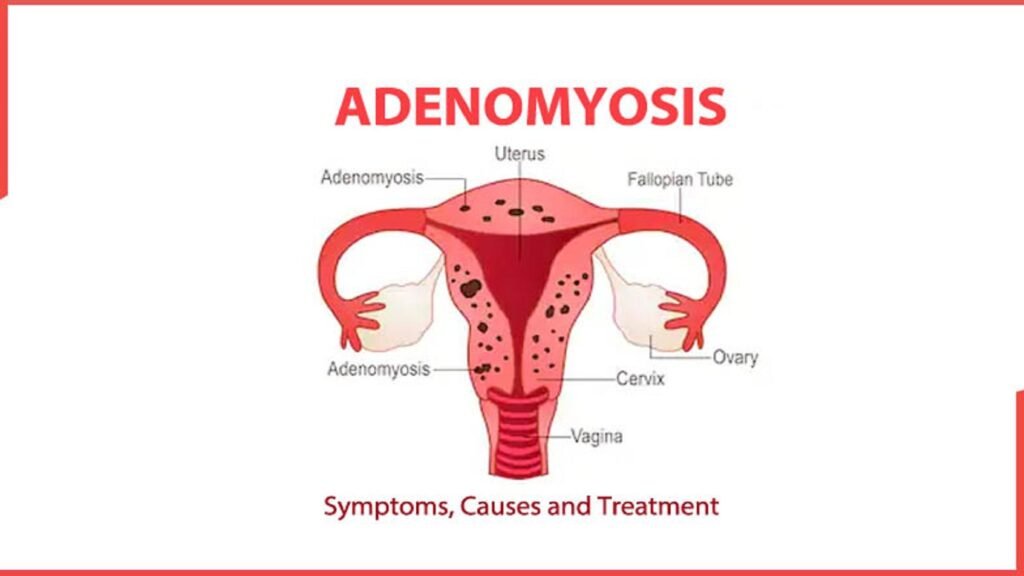
Adenomyosis is a condition in which tissue like the endometrium (womb lining) grows into the myometrium (muscle wall of the uterus). This misplaced tissue still responds to monthly hormones, so it swells and bleeds within the muscle.
Over time, the muscle thickens and the uterus becomes enlarged, soft and tender, often called a “bulky uterus” on scan reports. Adenomyosis can be diffuse (spread through the wall) or focal (a localised lump called an adenomyoma, which can look like a fibroid).
It is not cancer and does not turn into cancer.
What causes adenomyosis, and who gets it?
The exact cause is unclear. The leading theory is that the boundary between the lining and the muscle is disrupted, allowing lining cells to grow inward.
- Age: most common in women in their 30s and 40s.
- Previous pregnancies: women who have given birth appear to be at higher risk.
- Uterine surgery: caesarean section, fibroid removal or repeated D&C may contribute.
- Oestrogen exposure: adenomyosis is hormone-sensitive and usually fades after menopause; see how hormones drive adenomyosis progression.
- Coexisting conditions: endometriosis and fibroids often occur alongside it.
What are the symptoms of adenomyosis?
The commonest symptoms are heavy menstrual bleeding and painful periods that get worse over the years. About a third of women have few or no symptoms.
- Heavy or prolonged periods, sometimes with clots and anaemia. Read more on adenomyosis and heavy bleeding.
- Severe cramping that may start before the period.
- Pelvic pressure, heaviness or bloating, and a lower tummy that feels swollen.
- Pain during sex.
- Chronic pelvic pain between periods in some women.
- Difficulty conceiving or miscarriage in some cases; see adenomyosis and fertility.
How is adenomyosis different from endometriosis and fibroids?
All three can cause painful or heavy periods, but they sit in different places and are treated differently.
| Feature | Adenomyosis | Endometriosis | Fibroids |
|---|---|---|---|
| Where it grows | Inside the uterine muscle | Outside the uterus (ovaries, pelvis) | Benign muscle lumps in or on the uterus |
| Typical symptoms | Heavy, painful periods; bulky uterus | Pelvic pain, painful sex, bowel symptoms, infertility | Heavy periods, pressure, frequent urination |
| Usual imaging | Transvaginal ultrasound, MRI | Ultrasound, MRI; laparoscopy if needed | Ultrasound |
| Can it be removed cleanly? | Rarely; it blends into muscle | Lesions can be excised | Usually yes (myomectomy) |
When adenomyosis and deep endometriosis coexist, planning needs extra care; see treatment of adenomyosis with deep endometriosis.
How is adenomyosis diagnosed?
Adenomyosis is usually diagnosed with a transvaginal ultrasound, supported by MRI when the picture is unclear. There is no blood test for it.
On ultrasound, signs include an enlarged, globular uterus, asymmetric thickening of the walls, small cysts within the muscle and a blurred junction between lining and muscle. Your doctor will also check haemoglobin if bleeding is heavy, and may examine the uterine cavity by hysteroscopy to rule out polyps.
What are the treatment options for adenomyosis?
Treatment depends on how severe your symptoms are, your age and whether you want to become pregnant. Most women start with medicines.
- Pain relief: NSAIDs taken from the start of the period.
- Non-hormonal bleeding control: tranexamic acid on heavy days.
- Hormonal IUS (LNG-IUS): often the first choice when pregnancy is not planned; it reduces bleeding and pain.
- Progestogens, combined pill or GnRH analogues: to suppress the tissue.
- Uterus-sparing procedures: uterine artery embolisation, focused ultrasound or removal of a focal adenomyoma in selected women.
- Hysterectomy: the only definitive cure, for women who have completed their family.
Each option is compared in detail in adenomyosis treatment options: medical and surgical.
When to see a gynaecologist
Heavy or painful periods are common, but they are not something you simply have to put up with. See a gynaecologist if you notice:
- Soaking a pad or tampon every one to two hours, or passing large clots
- Periods lasting more than seven days
- Tiredness, breathlessness or dizziness suggesting anaemia
- Period pain that keeps getting worse or no longer responds to painkillers
- Bleeding between periods, after sex or after menopause
- Difficulty conceiving or repeated miscarriage
Very heavy bleeding with fainting or a racing heart needs emergency care.
How Dr. Divya Venugopalan can help
Dr. Divya Venugopalan evaluates adenomyosis with a careful history, examination and detailed transvaginal ultrasound, and explains what the findings mean for your symptoms and plans. Read more about her adenomyosis treatment and heavy menstrual bleeding care.
Her training in minimal access surgery (FMAS) allows her to offer hysteroscopy and laparoscopy when needed, while her fellowship in reproductive medicine (FRM) helps women who want to conceive choose fertility-friendly treatment.
She consults at Thanisandra, Sahakar Nagar and HRBR Layout, Bengaluru. Book a consultation to discuss your options.
Frequently asked questions
Is adenomyosis serious?
Adenomyosis is benign, but heavy bleeding and pain can seriously affect quality of life and cause anaemia. With the right treatment, most women get good relief.
Can adenomyosis go away on its own?
It usually does not resolve before menopause, but symptoms often improve after menopause as oestrogen falls. Medicines can control it well in the meantime.
Can I get pregnant with adenomyosis?
Yes, many women conceive, although adenomyosis can lower the chance of implantation and slightly raise the risk of miscarriage. A fertility specialist can plan treatment to improve your chances.
Does adenomyosis cause weight gain?
Adenomyosis itself does not cause weight gain, but an enlarged uterus can make the lower tummy look swollen or bloated.
Is hysterectomy the only cure for adenomyosis?
Hysterectomy is the only definitive cure, but most women do not need it. Hormonal treatment and uterus-sparing procedures control symptoms for many.
Medically reviewed by: Dr. Divya Venugopalan, MBBS, DNB (OBG), FRM, FMAS. Gynaecologist & fertility specialist, Bengaluru (KMC Reg. No. 91293). Last reviewed: 27 October 2026.
This article is for general information and does not replace a personal consultation. In an emergency, visit the nearest hospital emergency department.