Quick answer: Endometriosis diagnosis begins with a detailed history and pelvic examination, followed by transvaginal ultrasound, which can detect ovarian cysts (endometriomas) and deep disease. MRI maps complex or deep endometriosis. Laparoscopy, with biopsy, is used when imaging is normal but symptoms persist or surgery is planned. Blood tests such as CA-125 cannot confirm it.
Key takeaways
- Diagnosis is often delayed by several years because symptoms overlap with normal period pain, IBS and urinary problems.
- A normal scan does not rule out endometriosis; small surface lesions are not visible on imaging.
- Expert transvaginal ultrasound is the first-line test and can detect endometriomas and many deep lesions.
- Current guidelines support starting treatment on a clinical or imaging diagnosis without routine laparoscopy.
- Laparoscopy remains useful when imaging is negative and treatment has failed, or when surgery is needed anyway.
Why is endometriosis so hard to diagnose?
Endometriosis is often missed because its symptoms are common to many conditions and the lesions can be tiny. Many women are told their pain is “normal” before they are diagnosed.
Painful periods, bloating and bowel upset overlap with irritable bowel syndrome; bladder pain can mimic urinary infections. Superficial lesions on the pelvic lining may be only a few millimetres across and do not show up on scans. An overview of the condition is in our endometriosis guide.
What happens at the first consultation?
Your doctor will take a detailed history and, with your consent, examine you. This step alone often raises a strong suspicion of endometriosis.
- Symptom history: timing of pain in relation to periods, pain with sex, bowel or bladder symptoms, and fertility. Tracking how symptoms change across the month helps; see how endometriosis affects the menstrual cycle.
- Family history: endometriosis in a mother or sister increases likelihood.
- Pelvic examination: may find tenderness, nodules behind the uterus, a fixed uterus or an ovarian swelling. It can be normal in early disease.
How does ultrasound help diagnose endometriosis?
Transvaginal ultrasound is the first-line imaging test. In experienced hands it reliably detects ovarian endometriomas and many deep endometriosis nodules.
- Endometriomas: ovarian cysts with a typical “ground glass” appearance.
- Deep endometriosis: nodules behind the uterus, on the bowel, bladder or ligaments, seen with a systematic scan.
- Sliding sign: checks whether the uterus moves freely against the bowel; a negative sign suggests adhesions.
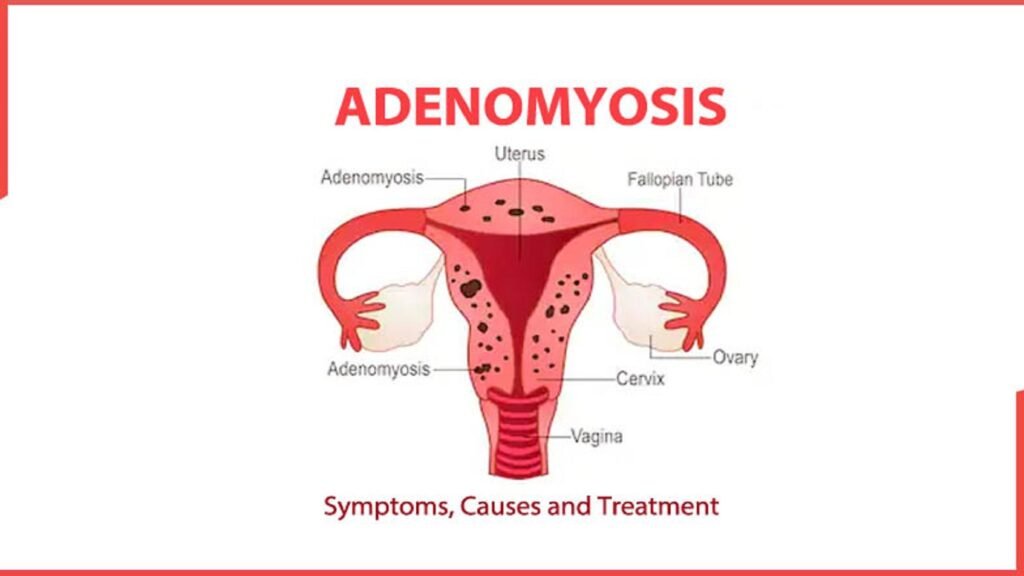
- Adenomyosis: which often coexists, can be assessed at the same time.
A transabdominal scan is used for women who prefer not to have, or are not suitable for, an internal scan, but it shows less detail. A normal routine scan does not exclude superficial disease.
When is an MRI needed for endometriosis?
MRI is used when ultrasound findings are unclear, when deep disease is suspected, or to plan surgery.
It gives a detailed map of deep endometriosis involving the bowel, bladder, ureters or pelvic side walls and of coexisting adenomyosis. This helps the surgeon plan and decide whether other specialists, such as a colorectal surgeon or urologist, should be involved. Like ultrasound, MRI may miss small surface lesions. Mapping complex cases is discussed in adenomyosis with deep endometriosis treatment.
Is laparoscopy still needed to diagnose endometriosis?
Laparoscopy is no longer required for every woman, but it remains the only way to see and confirm superficial disease directly.
During keyhole surgery under general anaesthesia, a camera is passed through a small cut near the navel. Lesions can be seen, sampled for biopsy and, in many cases, removed at the same time. It is considered when imaging is normal but symptoms persist despite treatment, when there is a large or suspicious cyst, or when surgery is planned for pain or fertility.
How do the diagnostic tests compare?
| Test | What it shows well | Limitations |
|---|---|---|
| History and examination | Pattern of symptoms, tenderness, nodules | Can be normal in early disease |
| Transvaginal ultrasound | Endometriomas, many deep nodules, adenomyosis | Operator-dependent; misses superficial lesions |
| MRI | Detailed map of deep disease before surgery | Costlier; misses small surface lesions |
| Laparoscopy with biopsy | Direct view and confirmation; treatment at the same time | Surgery and anaesthesia risks |
| CA-125 blood test | May be raised in some women | Not specific; cannot diagnose or exclude |
Costs depend on the tests needed, the scanning centre, anaesthesia and whether treatment is carried out during laparoscopy.
When to see a gynaecologist
See a gynaecologist for assessment if you have:
- Period pain that stops you from working, studying or sleeping
- Pelvic pain between periods lasting more than a few months
- Deep pain during sex
- Painful bowel movements or urination around periods
- Difficulty conceiving
- A known ovarian cyst with sudden severe pain, fever or vomiting, which needs urgent care
How Dr. Divya Venugopalan can help
Dr. Divya Venugopalan takes a careful history, performs a gentle examination and arranges targeted transvaginal ultrasound or MRI to reach a clear diagnosis without unnecessary surgery. Read more about her endometriosis treatment.
When laparoscopy is needed, her FMAS training allows her to perform diagnostic and operative laparoscopy, often treating lesions in the same procedure. If fertility is a concern, she can add tubal testing and ovarian reserve tests as part of the plan.
Book an appointment at Thanisandra, Sahakar Nagar or HRBR Layout.
Frequently asked questions
Can a normal ultrasound rule out endometriosis?
No. A normal ultrasound makes large cysts and many deep nodules unlikely, but small superficial lesions can be missed. If symptoms continue, further assessment may be needed.
Can a blood test diagnose endometriosis?
No blood test can confirm or rule out endometriosis. CA-125 may be raised but is not specific enough to diagnose it.
Do I need laparoscopy to start treatment?
Usually not. Current guidelines support starting pain treatment based on symptoms, examination and imaging. Laparoscopy is considered if treatment fails or surgery is needed.
Is laparoscopy for endometriosis painful?
It is done under general anaesthesia, so you feel nothing during the procedure. Afterwards, mild abdominal and shoulder discomfort is common for a few days.
How long does it take to diagnose endometriosis?
With a focused assessment, a working diagnosis can often be made at the first or second visit. Confirmation by laparoscopy, if needed, is planned separately.
Medically reviewed by: Dr. Divya Venugopalan, MBBS, DNB (OBG), FRM, FMAS. Gynaecologist & fertility specialist, Bengaluru (KMC Reg. No. 91293). Last reviewed: 27 October 2026.
This article is for general information and does not replace a personal consultation. In an emergency, visit the nearest hospital emergency department.