
Egg Freezing in Bengaluru: Process, Best Age and Success
Quick answer: Egg freezing (oocyte cryopreservation) lets a woman store her eggs for a future pregnancy. The ovaries are stimulated with injections for about 10–12 days, the eggs are collected in a short day-care procedure and frozen by vitrification. It works best before 35, and the chance of a future baby depends mainly on age at freezing and the number of eggs stored.
Key takeaways
- Egg quality and number fall with age, especially after 35, so earlier freezing gives better results.
- Vitrification (ultra-rapid freezing) means most frozen eggs survive thawing.
- One cycle takes about two weeks from the start of injections to egg collection.
- Frozen eggs are later thawed, fertilised by ICSI and transferred as embryos.
- Egg freezing improves the odds of a future pregnancy but cannot guarantee a baby.
What is egg freezing?
Egg freezing is a way of preserving fertility. Mature eggs are collected from the ovaries and stored in liquid nitrogen at –196 °C until you are ready to try for a pregnancy.
Modern laboratories use vitrification, which cools eggs so quickly that damaging ice crystals do not form. Because an egg is frozen at the age you are when it is collected, a woman who freezes at 32 and uses her eggs at 40 has a chance of success closer to that of a 32-year-old’s eggs, although pregnancy at an older age carries its own health considerations.
Who should consider egg freezing?
Planned (elective) egg freezing
- Women who wish to delay pregnancy for career, education, personal or relationship reasons.
- Women with a lower-than-expected ovarian reserve (low AMH) on testing.
- Women with a family history of early menopause.
Medical egg freezing
- Before chemotherapy, radiotherapy or surgery that may damage the ovaries.
- Women with endometriosis who need ovarian surgery.
- Some autoimmune or genetic conditions linked to early ovarian failure.
Couples going through IVF may also freeze extra eggs, and men can preserve fertility through sperm freezing.
What to expect: step by step
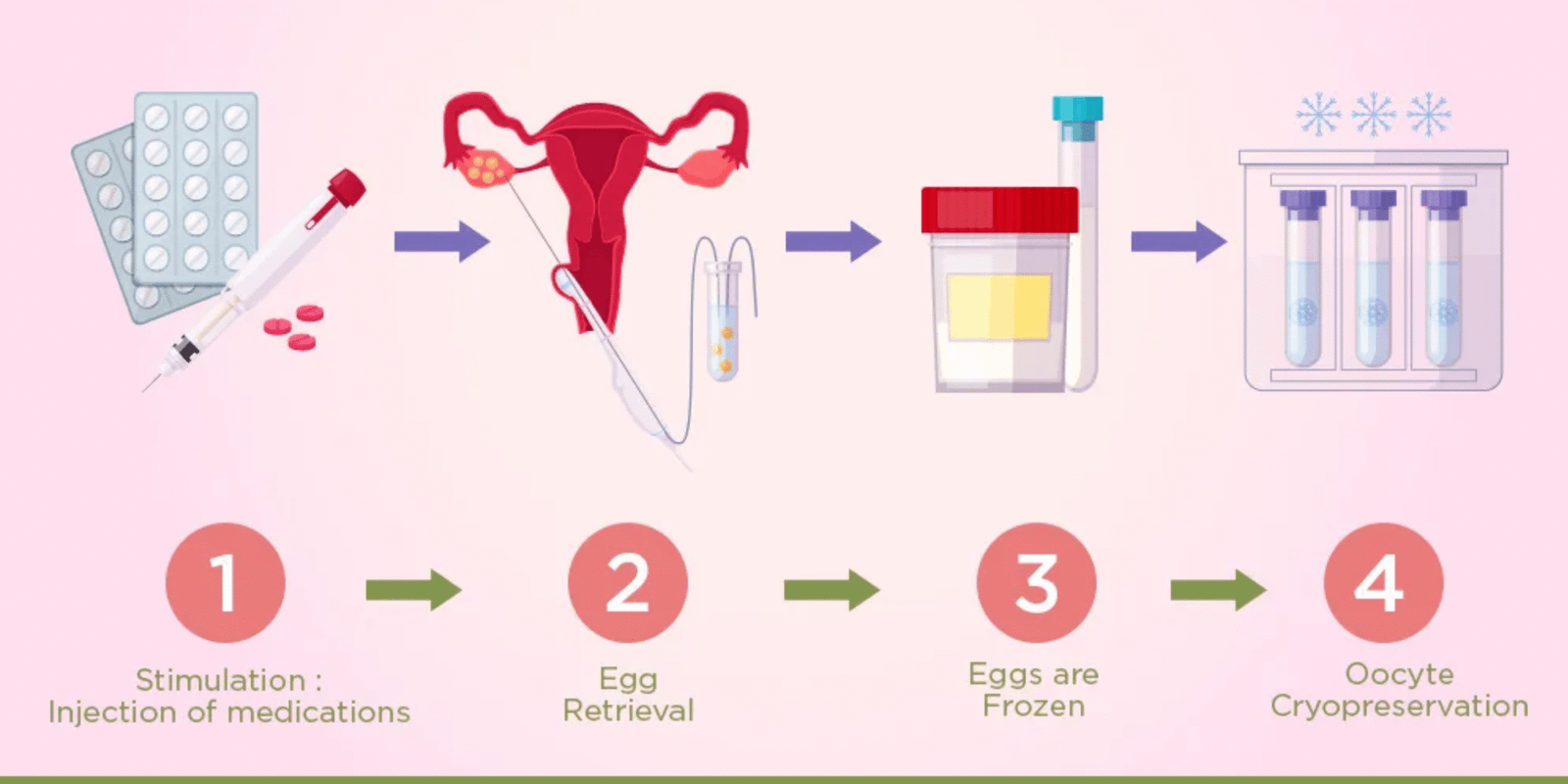
- Consultation and tests. AMH blood test, antral follicle count on ultrasound, thyroid and infection screening, and a discussion of your goals.
- Ovarian stimulation. Daily hormone injections, usually self-given under the skin, for about 10–12 days to grow several follicles.
- Monitoring. Three to four ultrasound scans, with blood tests as needed, to adjust the dose.
- Trigger injection. Given when follicles are mature.
- Egg collection. About 34–36 hours later, under short anaesthesia, using a fine needle passed through the vagina under ultrasound guidance. It takes 15–30 minutes.
- Vitrification and storage. Mature eggs are frozen the same day and stored securely, with consent forms that set out the storage terms.
- Future use. When you are ready, eggs are thawed, fertilised with sperm by ICSI, and an embryo is transferred to the uterus.
For women facing urgent cancer treatment, stimulation can often start at any point in the cycle so that freezing is not delayed.
What are the chances of a baby from frozen eggs?
The two strongest factors are your age at freezing and the number of mature eggs stored. Not every egg survives thawing, fertilises and becomes a healthy embryo, so several eggs are needed for each realistic chance of a baby.
| Age at freezing | What to expect |
|---|---|
| Under 35 | Best egg quality; around 10–15 mature eggs give a reasonable chance of a future live birth |
| 35–37 | Still worthwhile; more eggs, and sometimes two cycles, may be needed |
| 38–40 | Lower chance per egg; multiple cycles are often advised |
| Over 40 | Success with own frozen eggs is limited; options are discussed individually |
What are the risks and side effects?
- Injection effects: bloating, breast tenderness, mood changes and bruising.
- Ovarian hyperstimulation syndrome (OHSS): uncommon with modern protocols, and the risk is lower because no embryo is transferred in the same cycle.
- Egg collection: cramping and spotting for a day or two; bleeding or infection is rare.
- No guarantee: some women will not have a baby from their frozen eggs, so it is important to start with realistic expectations.
Recovery and aftercare
Rest on the day of egg collection and avoid driving because of the anaesthesia. Most women go back to work the next day. Mild bloating can last until your next period, which usually arrives 10–14 days later. Avoid strenuous exercise for about a week, drink plenty of fluids, and call your doctor for severe pain, vomiting, a rapidly swelling abdomen, breathlessness or fever.
How much does egg freezing cost?
The cost varies with each woman’s plan. It depends on:
- the dose and duration of stimulation medicines;
- the number of monitoring scans and blood tests;
- egg collection, anaesthesia and vitrification charges;
- annual storage fees;
- whether more than one cycle is needed;
- future thawing, ICSI and embryo transfer when the eggs are used.
When to see a doctor
Book a fertility consultation if you are in your late twenties or early thirties and expect to delay pregnancy, if you have been told your AMH is low, if you have a family history of early menopause, or if you have just been diagnosed with cancer and fertility matters to you (seek advice before treatment begins). Irregular periods, endometriosis or planned ovarian surgery are also good reasons to talk to a specialist early.
Why choose Dr. Divya Venugopalan
Dr. Divya Venugopalan is a fertility specialist and gynaecologist in Bengaluru with more than 14 years of experience. She holds an MBBS from KIMS, a DNB in Obstetrics & Gynaecology and a Fellowship in Reproductive Medicine (FRM), and is a member of IFS and ISAR.
She uses your AMH and scan results to give a personalised estimate of how many eggs you are likely to need, and explains the process, legal consent requirements under the ART (Regulation) Act, 2021 and storage options clearly. Book a consultation at Thanisandra, Sahakar Nagar or HRBR Layout.
Frequently Asked Questions
What is the best age to freeze eggs?
Ideally before 35, when egg quality and numbers are better. Freezing between 35 and 38 is still worthwhile, though more eggs and sometimes more than one cycle may be needed.
How many eggs should I freeze?
As a rough guide, around 10–15 mature eggs for women under 35, and more for older women, give a reasonable chance of a future pregnancy. Dr. Divya personalises this using your AMH and scan results.
How long can frozen eggs be stored?
Vitrified eggs remain viable for many years without losing quality. The permitted storage period in India is governed by the ART (Regulation) Act, 2021, and Dr. Divya will explain the current rules.
Is egg collection painful?
Egg collection is done under short anaesthesia, so you will not feel pain during the procedure. Mild cramps and bloating for a day or two afterwards are common.
Does egg freezing affect my natural fertility?
No. Stimulation uses eggs that would otherwise be lost in that cycle, so it does not bring menopause forward or reduce your remaining egg supply.
Are babies born from frozen eggs healthy?
Current evidence shows no increase in birth defects in babies born from vitrified eggs compared with those conceived through IVF using fresh eggs.
Medically reviewed by: Dr. Divya Venugopalan, MBBS, DNB (OBG), FRM, FMAS. Gynaecologist & fertility specialist, Bengaluru (KMC Reg. No. 91293). Last reviewed: 27 October 2026.
This page is for general information and does not replace a personal consultation. In an emergency, visit the nearest hospital emergency department.
Book a consultation with Dr. Divya → or call +91 99459 26987.